
AI Design Trends: The Latest in Artificial Intelligence and Design
Now more than ever, human creativity is complemented by artificial intelligence in ways both remarkable and thought-provoking. Let's take a closer look at how AI can empower designers to take their work to a whole new level.
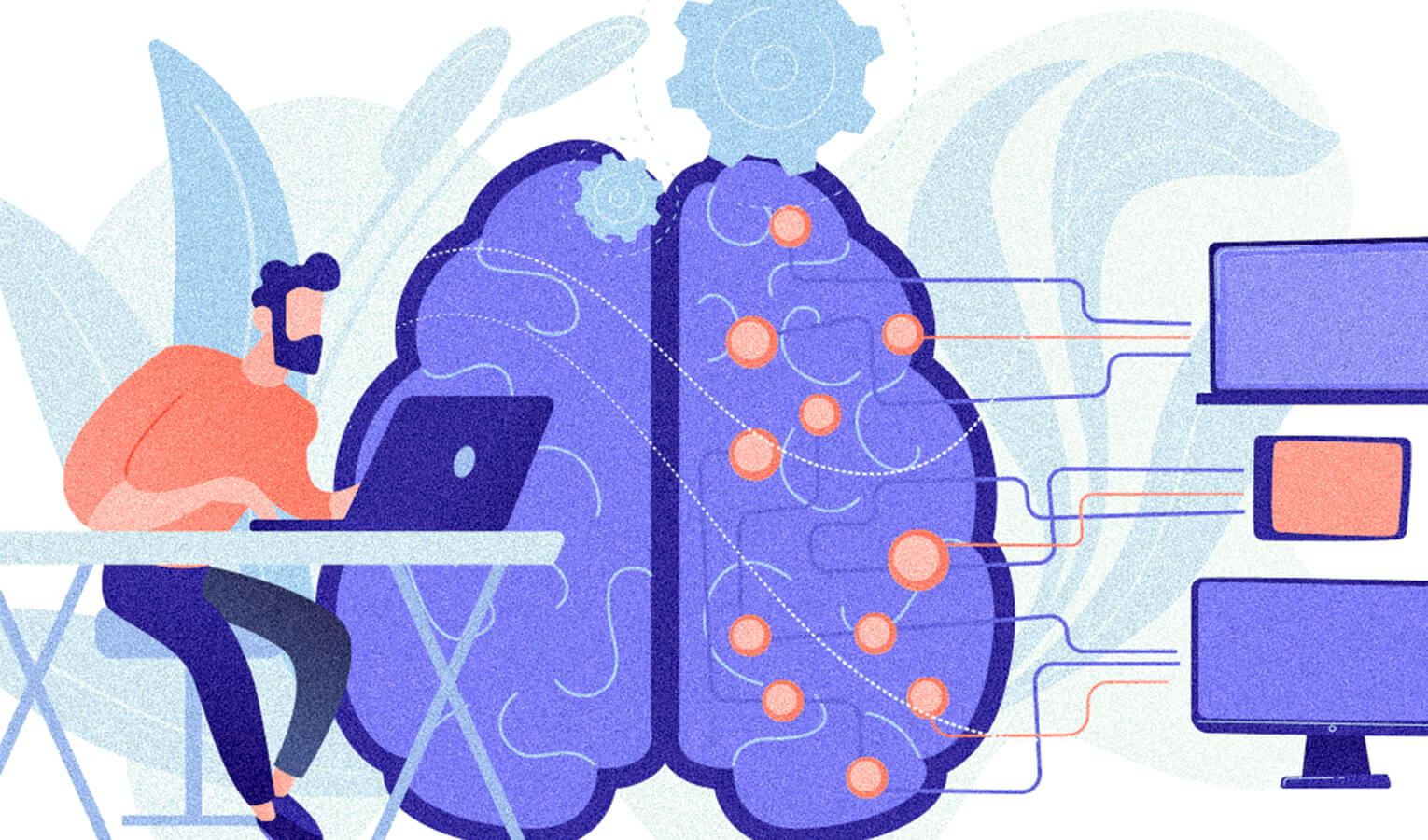




Artificial intelligence, or AI, is sometimes called machine intelligence. It’s one of the most exciting new technologies of our time, used by everyone from graphic designers and UX designers to marketers, content creators, and so on. With the ability to enhance the user experience across industries, AI empowers designers, innovators, and others to do so much. They can use generative AI tools to make text, images, or even videos in an instant, or use AI chatbots and design aids to create mobile apps, and user interfaces, or streamline their workflows like never before. The rapid rise of AI represents a broader cultural shift towards an increasingly technologically oriented age and an exciting new era for innovation around the world.
In the context of design, AI comes into play via two distinct phenomena: artificial intelligence optimizing the work of designers and artificial intelligence as a creative movement all on its own. When we talk about AI design boosting what designers create, such as the brushes within Adobe Fresco, we speak of how technology empowers designers to take their artworks to a whole new level. When we refer to this design trend as a creative movement, we’re touching on the aesthetics that operate on the continuous human-machine feedback loop. This is when a designer interacts with artificial intelligence in a sort of collaboration–producing mesmerizing visuals as the result. What follows is an in-depth look into the latest AI design trends in 2024.
The History of AI Design Innovations
To understand the history of neural network art, we have to understand the actual history of machine intelligence. If we go back far enough, we can see that AI has been referenced numerous times, even since antiquity. Think of mythology across all cultures, and their thought explorations with regard to artificial intelligence.
AI has also been spotlighted in fiction, such as, prominently, Mary Shelley’s gothic novel Frankenstein, which some arguably identify as being an origin point for steampunk design. AI research as a legitimate field of study debuted in 1956 at New Hampshire’s Dartmouth College. Coined by the late cognitive and computer scientist John McCarthy, artificial intelligence immediately expanded into computers:
-
Playing checkers
-
Tackling algebraic equations
-
Proving logical theorems
-
Even speaking English
By the 1960s, the U.S. Department of Defense even significantly funded research into machine learning. However, by the 1970s and early 1980s, funding and enthusiasm into this field of research notably dried up, leading to what’s been colloquially referred to as the AI winter. After hitting a bottom in the early 1990s, interest in AI and AI design has seen a resurgence in the late 1990s and into the 21st century. Artificial intelligence was increasingly utilized in data mining, medical diagnosis, and logistics. Perhaps the most noteworthy development toward the close of the 20th century was when Deep Blue, IBM’s chess-playing computer, beat the then-reigning world chess champion, Gary Kasparov, in 1997. Have a look at some artificial intelligence-inspired digital assets for further exploration of what this trend is all about:
In the 21st century, by 2011, AI had progressed to the point that IBM, again, created a question-answering machine named Watson to actually appear on the game show, Jeopardy!, where it beat the two most-winning champions in the show’s history. Gadgets and platforms that have recently benefitted from AI include:
-
Microsoft’s The Kinect, a body-movement user interface for both the Xbox 360 and Xbox One
-
AlphaGo, a computer program created specifically to play the board game Go (strategy game invented in China more than 2500 years ago)
-
Microsoft’s Skype-like system that translates languages
-
Facebook’s system that describes pictures to the blind
And that brings us all the way to 2018, which is seen by many as the point in time when artificial intelligence art came into the forefront. This is all thanks to something called generative adversarial networks or GANs for short. These are classes of artificial intelligence systems created by Ian Goodfellow, a machine-learning researcher. Long story short, GANs take a training set of information and then generate new information based on the qualities of the training set they receive. In layman’s terms, GANs can create images that look realistic to observers if they’re “trained†in photography. Of course, tools from companies like Adobe, such as Spark, empower artists to create AI design masterpieces. Adobe has also been flirting with making InDesign more AI-friendly, thus giving designers another tool to up their penchant for creating truly unique, digital artworks. These are examples of AI tools that make it easy to create AI designs, but there’s also dedicated artificial intelligence art that’s created by humans–who use these tools and others–and by machine learning itself. That’s what we’ll look at further in the next section.
The Characteristics of AI Design
It’s somewhat tricky to define the characteristics of neural network art because they’re largely based on superficial realism. That’s not to say that this design trend is surreal, like straightforward Surrealist Design, but more like a hard-to-spot duplication of real life (if that makes sense). And that’s where the fun begins. There are two, vital things to keep in mind:
-
What looks like a picture or portrait of a real person is actually not
-
What looks like it was rendered by the hand of a real artist is actually not
In other words, AI design means that, these days, machine learning has advanced to the point where it’s not really possible anymore to tell what was created by the human and what was created by the machine. Still, if you’re up for the challenge, here are some visual idiosyncrasies in artificial intelligence art to try to spy with your eagle eye:
-
Distortions — However slight, some artworks in this genre display, whether on purpose or not, fuzziness and jagged edges, making them a dead giveaway.
-
Too much perfection — While this is generally a very subjective term, when it comes to AI design, images (especially of people) will often look too symmetrical or too balanced…almost like they’ve been cloned (which they have, in a sense).
-
Angular features — This is a reference more so to illustrations rather than people’s faces; straight lines and geometrical shapes abound for the ultimate in abstraction.
-
Intricate patterning — Since machine-learning systems are capable of a lot of calculations, it’s no wonder that some visual artworks boast patterning so detailed and interesting that it’s easy to get lost trying to figure it all out.
-
Striking, vibrant colors — Not just the territory of flat design anymore, neural network art has shown that it, too, can compete with flat design and other modern trends in the area of bold, stirring colors.
-
Great attention to detail — Unlike design trends like naïve art, where the illustrations are purposefully more simplistic and rough around the edges, AI design means details galore, perhaps almost to a fault.
Take another look at a slew of digital assets inspired by machine learning to get your fill of this trend’s design characteristics:
With a trend as mind-bending as this, the best way to fully appreciate it is to see it in action.
Mind-Blowing Examples of AI Design Innovations
If you don’t do double takes with each of these examples, then we don’t know what to say! We scoured the web far and wide to bring you a stellar showcase of artificial intelligence art, whether human-created, machine-created, or a sophisticated combination of both.
ALAgrApHY’s Robotized Fembot
An artist and scientist based in Paris, ALAgrApHY takes AI and all its visual potential to new heights. The creator of many noteworthy works in this design movement, his machine-learning artwork demonstrates the intricate patterns that are possible with this technology and approach to art.
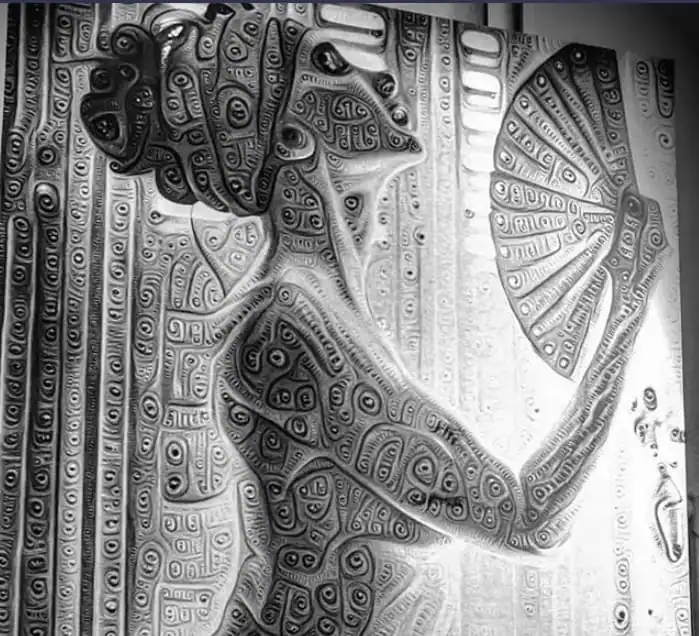
Image Credit: Alahay.org
His latest is this “fembot†fanning herself. What immediately stands out at the viewer is the presence of a multitude of “eyes†within the creation, which produces a pattern that, far from distracting, adds to the entire composition due to the visual texture it provides.
This Person Does Not Exist! — A Clever Example of AI-Based Web Design
One aspect of AI design trends that probably goes unnoticed by a lot of people is human image synthesis. This is when movies fabricate human characters by digitally composing them into a scene–even though they are not real people. The quirk with this technology is that it actually used to take a lot of human involvement to pull it off–but that’s a thing of the past. Nowadays, machine learning has advanced so far that these fake images are produced automatically by artificial intelligence without a human needing to lift their finger.

Image Credit: This Person Does Not Exist
That’s where This Person Does Not Exist comes into the–pardon the pun–picture. This website shows off an endlessly generating series of people’s images that are all created by AI. Note how lifelike these fake people look, but also how they look too perfect. For one, they all have perfect skin with no blemishes.
Beyond appreciating the creepiness of this application of AI, it’s also not lost on us how being able to easily fabricate realistic-looking images of all sorts of people is a recipe for fraud of all kinds.
Christie’s Portrait of Edmond Belamy — Generative AI Taken to New Heights
You know that AI design is getting big when even Christie’s, the renowned auction house that specializes in high-class art, has to get in on the action of art created by machine learning. Recently, in the fall of 2018, this auction house successfully sold a painting that was an artwork of artificial intelligence, rather than a human hand. You heard us right: This artwork is entirely the product of a machine. Titled the Portrait of Edmond Belamy, the digital piece came from algorithms, yet it still sold for an impressive $432,500. While art is always subjective–as are the prices attached to its works–the fact that a machine-learning algorithm could produce a painting worth nearly half a million dollars is stunning. For this reason, the concept of crafting high-end art purely with AI is one of the most popular AI design trends in 2024.
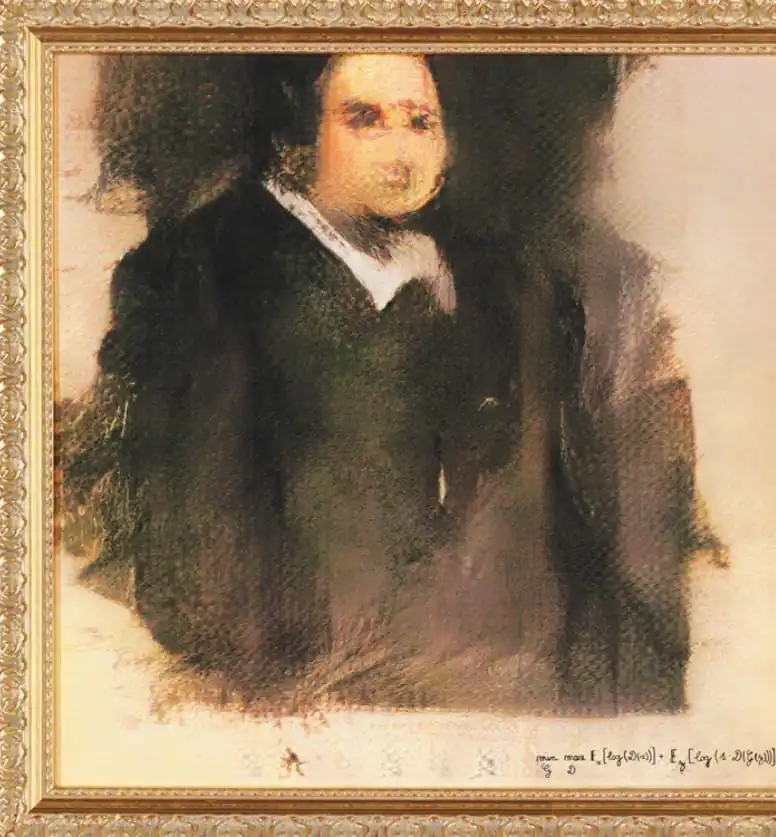
Image Credit: Christie’s
The actual painting is the work of a group of artists called Obvious, which is based in Paris. Their method was simple: They entered into their system a data set of thousands of paintings from the 14th to 20th centuries. One algorithm in the system is called the Generator while the other is named the Discriminator. The former creates new images from the data set, but the latter attempts to identify differences between human-created paintings and those produced by the Generator. If the second algorithm is tricked into thinking the newly created images from the Generator are made by humans, then a result (painting) is created.
Note how the portrait features heavy distortion and unclean lines, which (intentionally or not) creates the effect of mystery.
Sougwen Chung’s Artwork With Robots — AI and Human Creativity Combined
This may be the ultimate team-up between humans and machines for a perfectly balanced interpretation of AI design.
Whereas other forays into this nascent design movement involve the use of algorithms to spit out illustrations and paintings, Sougwen directly collaborates with machines to produce eye-catching artworks. Combining both hand-drawn illustrations with those of robot-created paintings, she’s able to come up with artificial intelligence art that also analyzes the relationship between human and machine communication.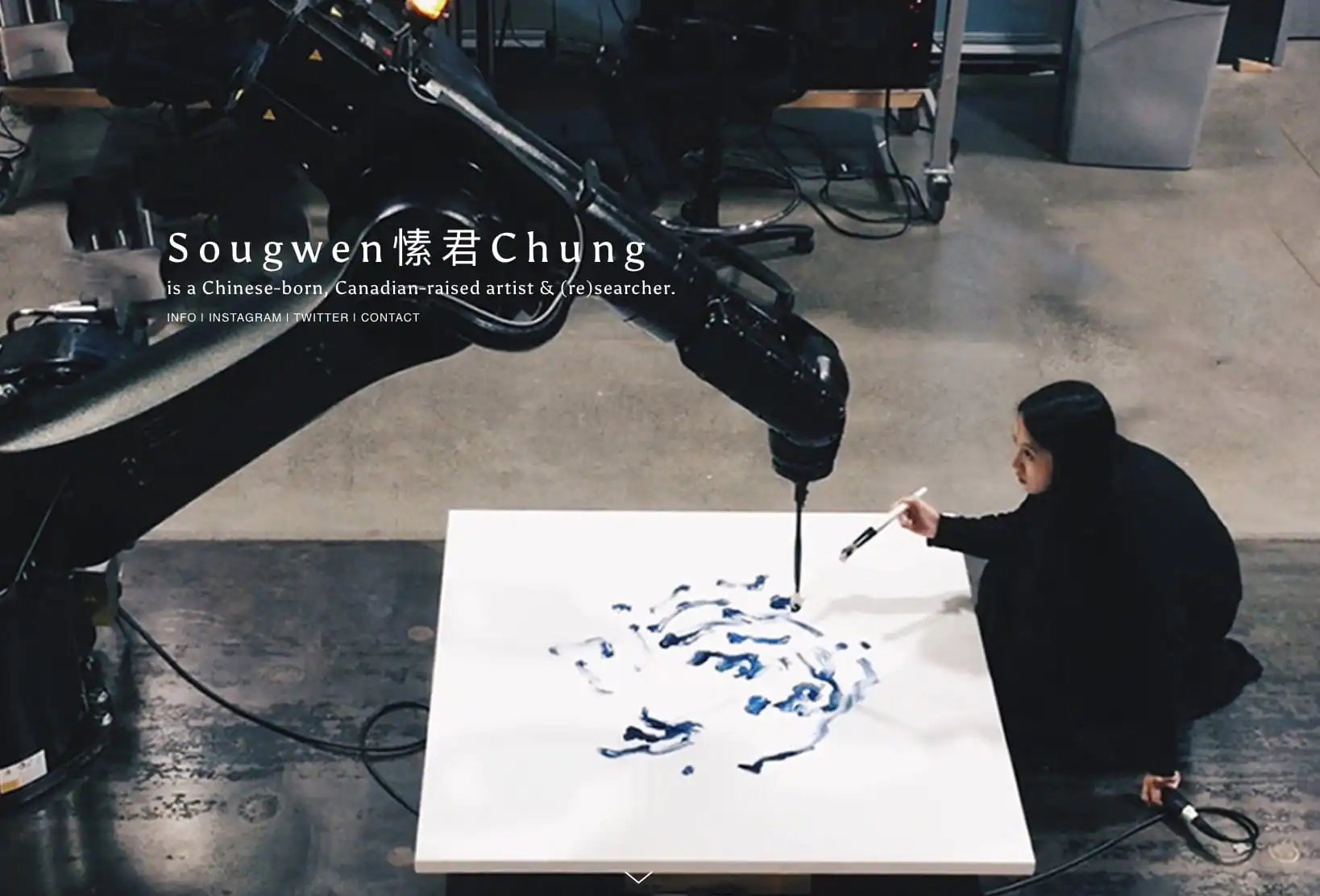
Image Credit: Sougwen.com
She’s also been a former research fellow with MIT’s Media Lab, allowing her to study the interaction between humans and machines firsthand.
Memo Akten’s AI-based Behavioral Abstractions — Transforming the Graphic Design Landscape
Hailing from Istanbul, Turkey, Memo Akten is a researcher from London who harnesses AI design to help people understand our world. Part and parcel of his Ph.D. work are artistic examinations of artificial intelligence, and he’s seen as a pioneer in this field.
His artificial intelligence artworks are expansive and eye-opening, spanning hourlong films, fundamental concepts in human nature, and the process at work behind neural networks.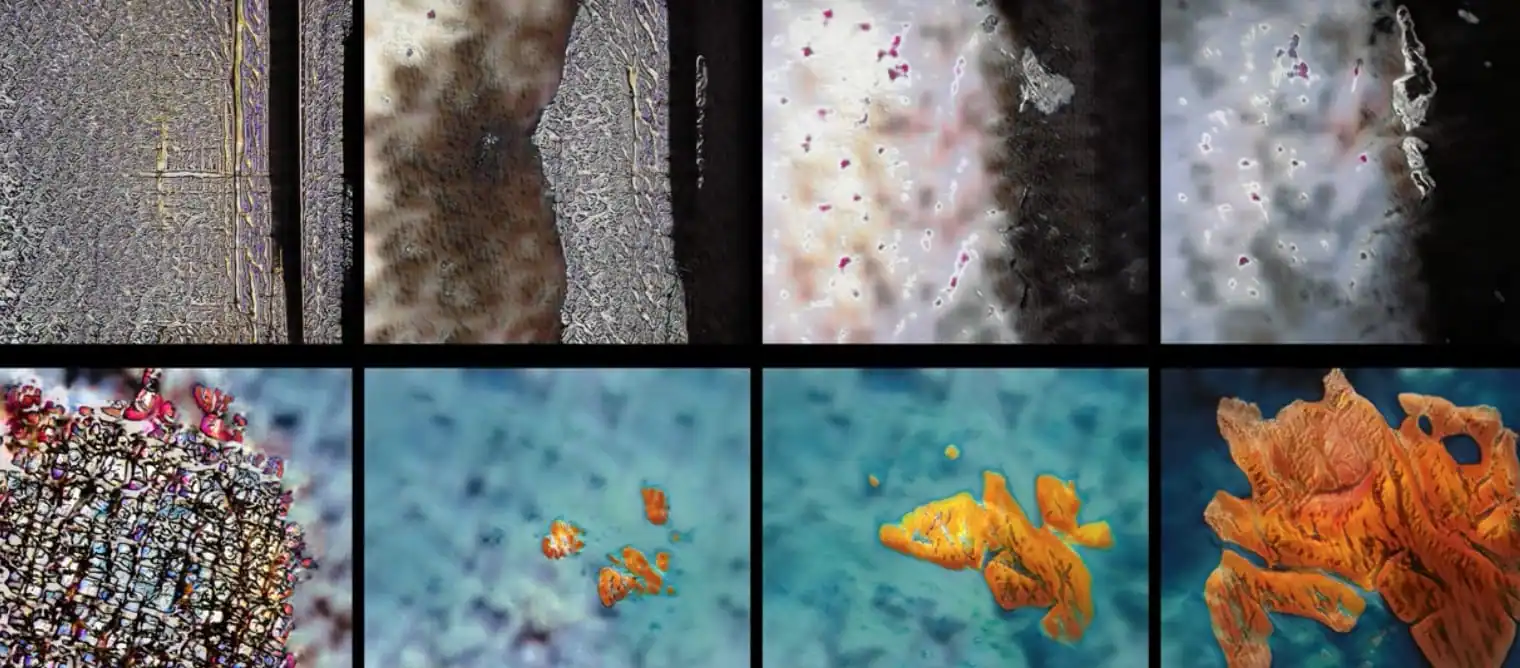
Image Credit: AI Artists
The end result of all this exploration and AI is nothing short of breathtaking, with his videos looking like a cross between a mind-bending Tool music video and some transcendental, visual experience.
His approach to AI design includes “training†algorithms to interpret a multitude of images and then programming it to theorize a whole, new cornucopia of images and possibilities from the starting dataset.
Scott Eaton’s Humanity-Based Artificial Intelligence Art
Fascinatingly, there are AI artists who specialize in only one discipline within the design movement. In Scott’s case, he is particularly interested in exploring the human form via generative artificial intelligence. Born in Washington, now living in London, Scott uses machine learning for his creative collaborations, making AI something like his creative partner.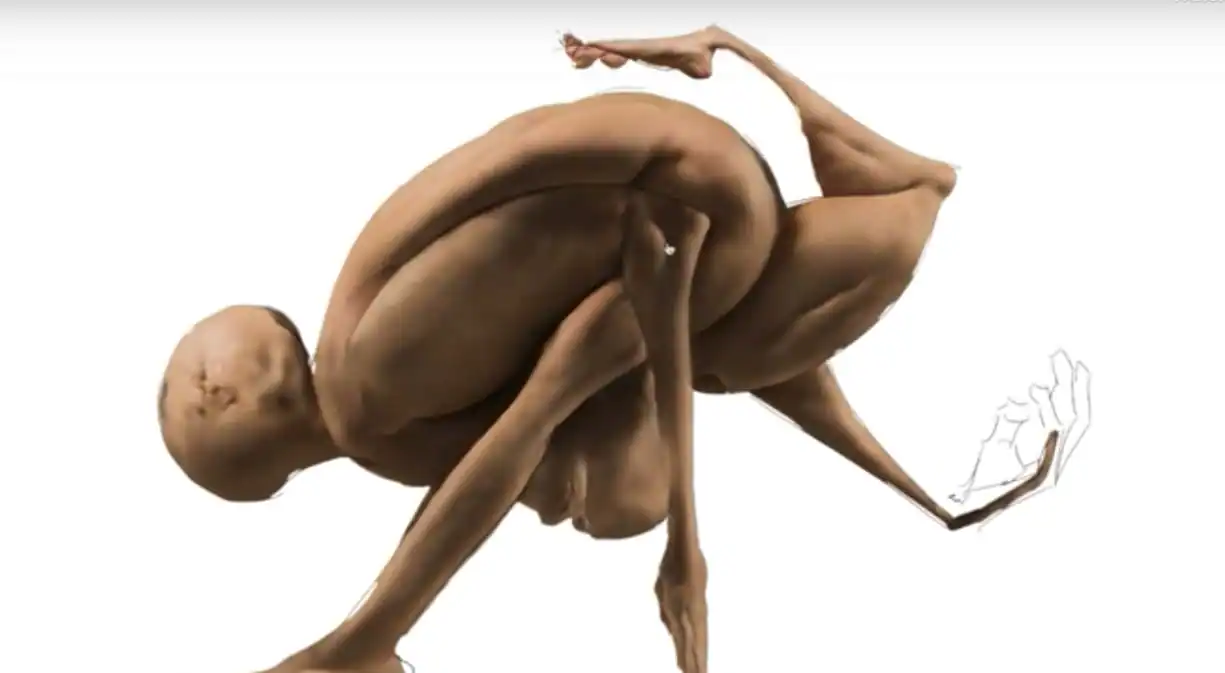
Image Credit: AI Artists
His interest in the human body has led to other, notable engagements, such as projects with gaming studios, visual effects, and straightforward animation.
One of his more famous sculptures is the Venus of Cupertino iPad Docking Station.
Ahmed Elgammal’s AICAN — Leveraging AI-Powered Design Tools for the Art Market
Ahmed Elgammal is a Rutgers University professor at its Department of Computer Science. He’s also the CEO of Artrendex, which is a startup that creates one-of-a-kind AI technology specifically for the art market. As such, he’s right in the center of AI design, with its mix of technology and illustration.
One of his more interesting AI projects is something called AICAN, an acronym that stands for artificial intelligence creative adversarial network. It’s a computer that’s an artificial intelligence artist and creative collaborative partner. This machine has produced a plethora of vibrant, unique, and eye-catching artwork over the years. These have been showcased in exhibitions around the world, and one AICAN piece even netted $16,000 at auction.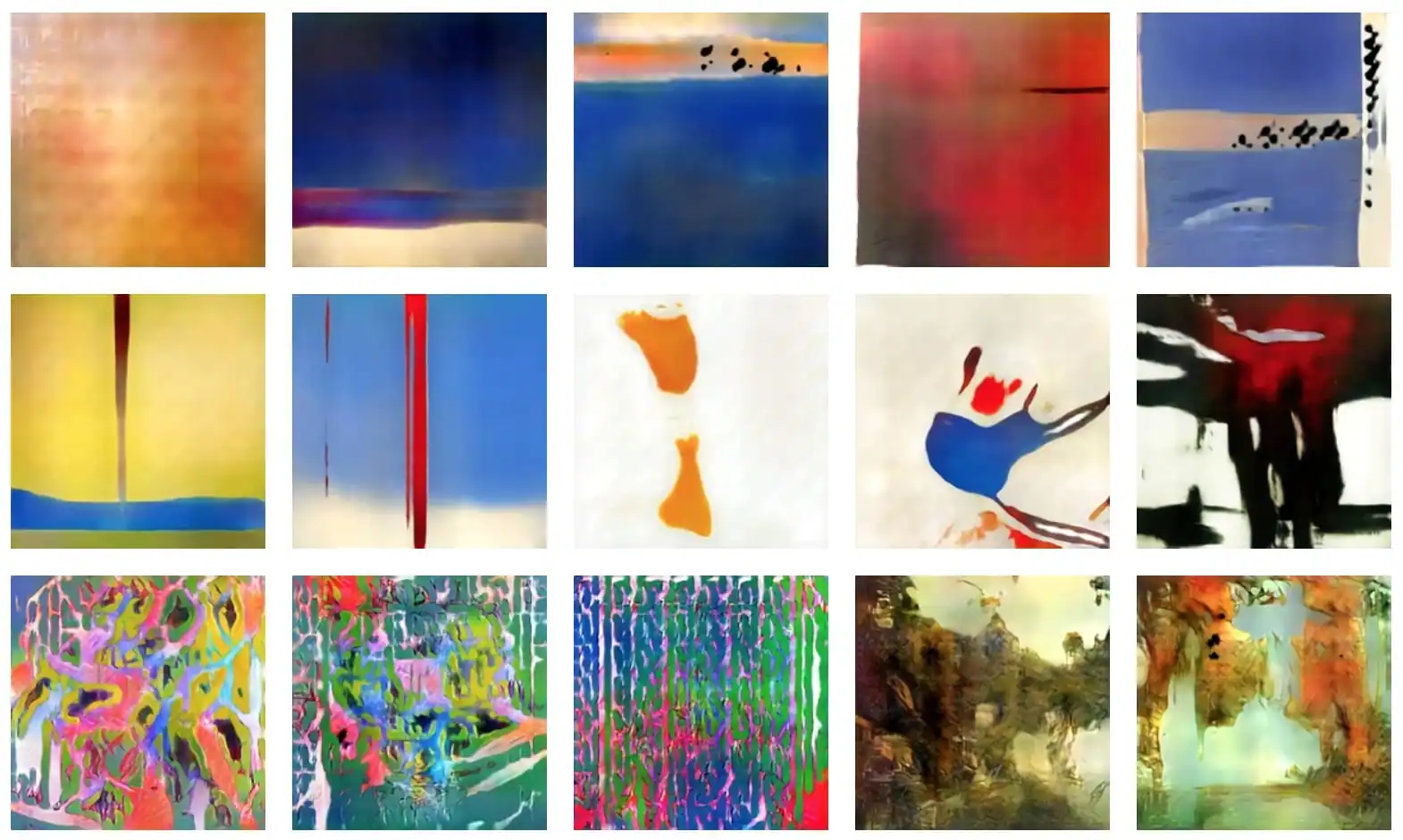
Image Credit: AICAN
AICAN’s neural art is so realistic that it’s impossible to tell it apart from a human hand. Its AI design is at once colorful, bold, random, and thought-provoking.
Christian Mio Loclair’s Narciss
What if a machine (read: an inanimate object) could actually contemplate itself? That’s what AI designer Christian Mio Loclair’s Narciss is devoted to exploring. Billed as the first machine that actually thinks about itself, Narciss is a machine that sits across from a mirror, so it can continually analyze itself.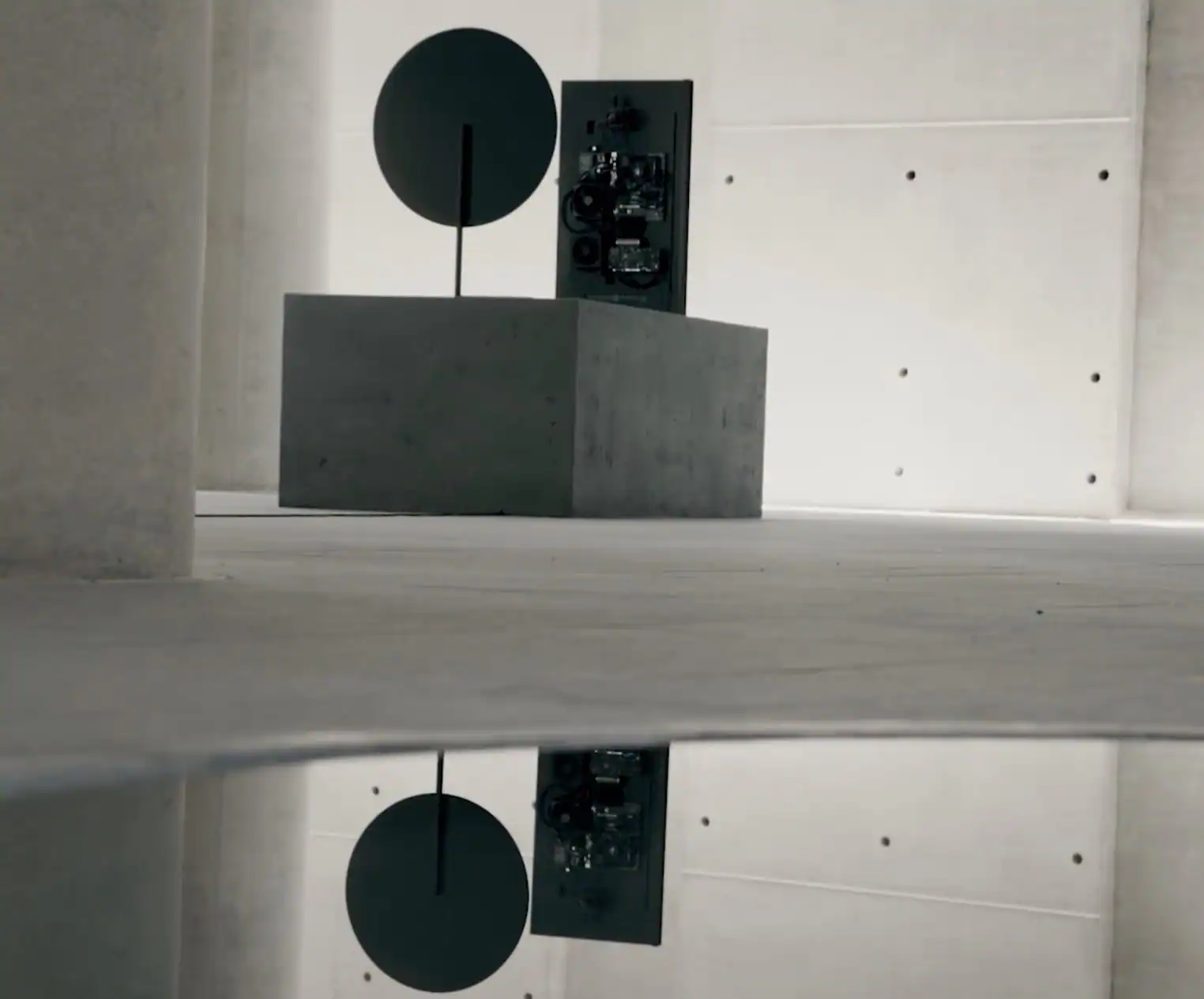
Image Credit: Christian Mio Loclair
The mirror and the machine symbolize input and output of data. Their relationship is such that they are oblivious to everything else around them, caring only for their infinite cycle of representation and then interpretation. This sculpture is outfitted with a CPU, GPU, cooler, and a hard drive, thereby allowing the machine to independently self-examine.
In this way, Narciss is a machine, but it’s also a work of art that both epitomizes AI design and partakes in artificial-intelligence experimentation.
How Next-Level Is Artificial Intelligence Art?
Machine learning continues to integrate with the human hand in all sorts of design. Now more than ever, human creativity is complemented by artificial intelligence in ways both remarkable and thought-provoking. To be sure, AI design is still in its infancy. What you’re witnessing today in this movement is only its beginning, and its potential is basically limitless, the more technology advances. In other words, if you’ve been impressed with the stunning visuals of this movement in the artworks we covered, then you’ll be excited to hear that this is just the beginning! You haven’t seen anything yet.
Products Seen In This Post:
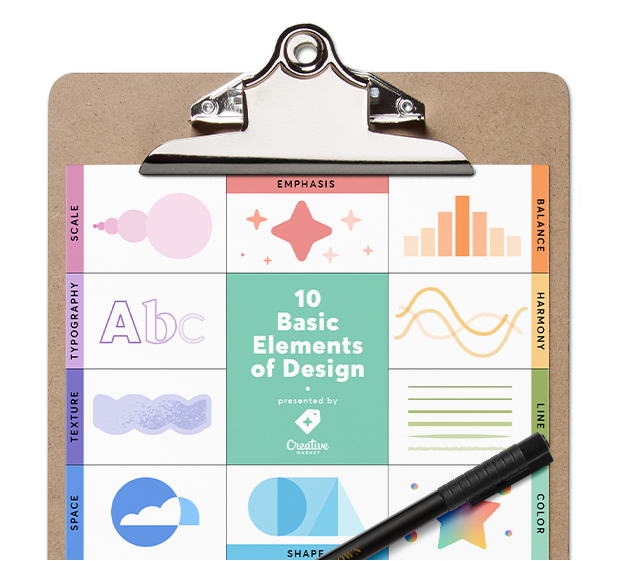
Download this printable PDF poster and hang these 10 design principles on your favorite wall.
Get the file


Marc is a copywriter and marketer who runs The Glorious Company, a marketing agency. An expert in business and marketing, he helps businesses and companies of all sizes get the most bang for their ad bucks.
View More Posts



6 Comments